
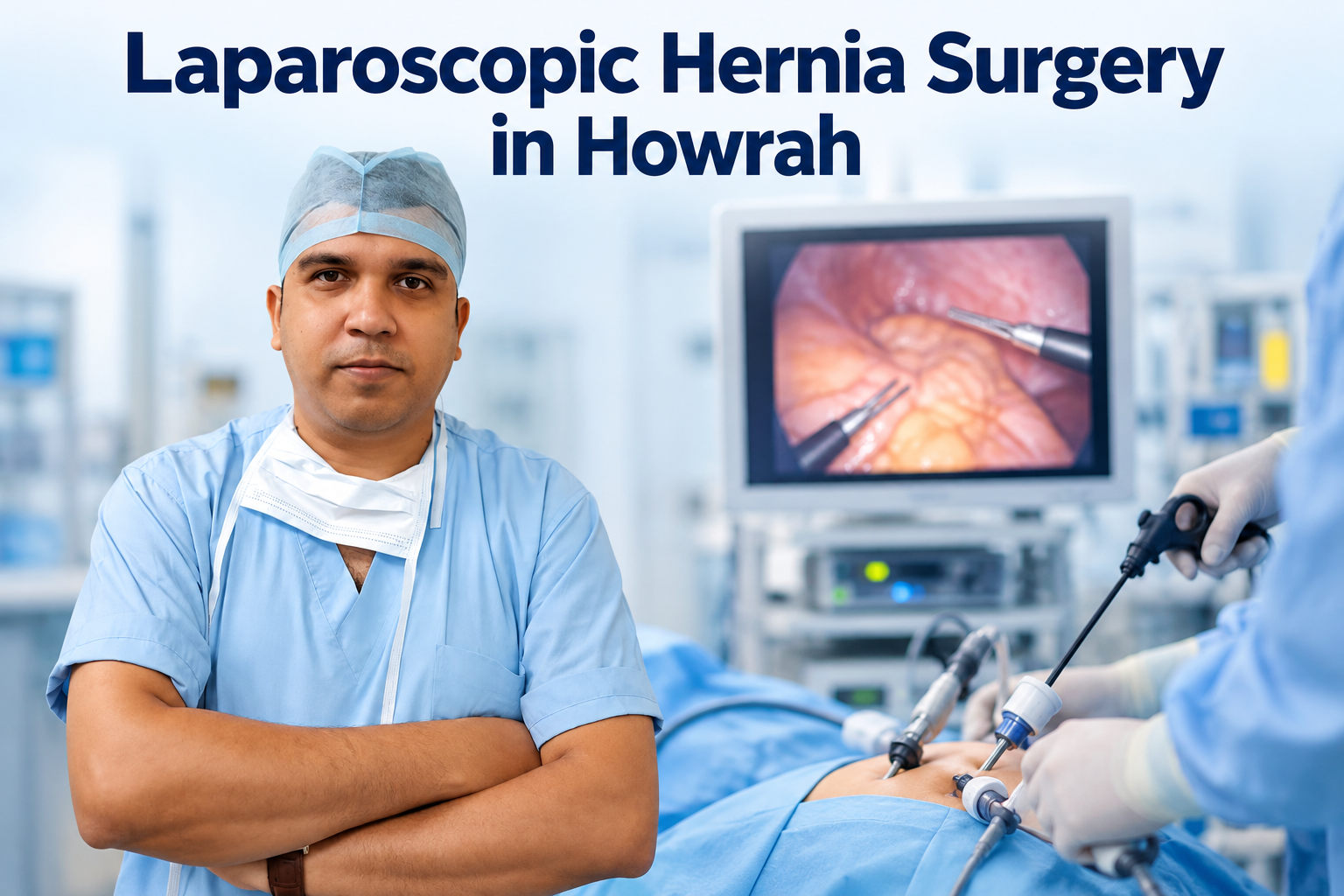
How to Choose a Laparoscopic Hernia Surgeon in Howrah: A Patient’s Guide
A small swelling in the groin can be easy to ignore at first. It may appear when you stand, cough or lift something and then seem to disappear when you lie down. For some people there is only a mild dragging sensation. For others, the discomfort gradually starts interfering with walking, work or everyday activities.
One possible cause is a hernia.
If you live in Howrah and have been told that you have a hernia, the next question is often straightforward: Do I need surgery, and if I do, should I have laparoscopic repair?
Choosing a surgeon should not be reduced to finding someone who simply advertises “laparoscopic surgery”. Hernia repair is a decision that depends on the type and position of the hernia, previous operations, general health and the surgeon’s experience with the technique being considered.
This guide explains what patients should know before choosing a laparoscopic hernia surgeon in Howrah and what to discuss during a consultation.
What is a hernia?
A hernia develops when tissue from inside the abdomen pushes through a weak area in the abdominal wall. The result may be a visible or palpable lump, although some hernias cause very little discomfort in the beginning.
An inguinal hernia occurs in the groin and is one of the most common types. Hernias can also occur around the navel, through an area of the abdominal wall weakened by an earlier operation, or at other points of weakness.
A groin hernia may become more noticeable while coughing, straining, standing or lifting. It may reduce when a person lies down. Some patients experience pain or a feeling of pressure, while others have very few symptoms.
The important point is that the size of a lump alone does not tell you whether an operation is necessary. The symptoms, examination findings and type of hernia all matter.
What does laparoscopic hernia surgery mean?
Laparoscopic hernia surgery is commonly described as keyhole surgery. Instead of making one larger incision directly over the hernia, the surgeon uses small incisions through which a camera and specialised instruments are introduced.
For laparoscopic inguinal hernia repair, the surgeon views the abdominal wall on a monitor, returns the protruding tissue to its appropriate position and reinforces the weak area, commonly with surgical mesh. The abdomen is temporarily inflated with carbon dioxide to create working space during the operation.
There are two established laparoscopic approaches for inguinal hernia repair, commonly referred to as TAPP and TEP. The choice is not simply a matter of which name sounds more advanced. The patient’s anatomy, previous surgery and the surgeon’s training and experience all have a role in deciding the appropriate approach.
Is laparoscopic surgery suitable for every hernia?
No. This is one of the most important things a patient should understand.
Laparoscopic repair can be a useful option for appropriately selected patients, but it is not automatically the best operation for every hernia. The type and location of the defect, its size, previous abdominal or hernia surgery, general health and ability to undergo general anaesthesia can influence the decision.
Previous surgery can sometimes leave scar tissue inside the abdomen, making keyhole surgery more difficult. There are also situations where the size or position of a hernia makes another approach more appropriate.
For that reason, a surgeon should examine the patient and discuss the available options rather than promising laparoscopic surgery before the hernia has been properly assessed.
Why surgeon experience matters in laparoscopic hernia repair
When patients compare surgeons, they often look first at qualifications, hospital location or online reviews. Those things can be useful, but they do not answer one important question: How experienced is the surgeon with the particular hernia operation being considered?
Laparoscopic hernia repair requires specific technical skills. NICE guidance has highlighted the importance of appropriate training and experience with laparoscopic techniques, particularly because these procedures are technically more demanding than open repair.
During your consultation, it is reasonable to ask:
- How often do you perform laparoscopic hernia repairs?
- Which types of hernia do you commonly treat?
- Which laparoscopic approach is being considered for my case?
- Why is laparoscopic repair suitable for me?
- Would open repair be a better alternative in my situation?
- What should I expect during recovery?
Laparoscopic versus open hernia repair
There are two broad surgical approaches to many hernias: open repair and laparoscopic repair.
With open repair, the surgeon makes an incision over the affected area, repairs the defect and may reinforce it with mesh. With laparoscopic repair, several smaller abdominal incisions are used for the camera and instruments.
For some patients, laparoscopic surgery may offer advantages such as smaller skin incisions and the possibility of addressing suitable bilateral groin hernias through the same operative access. It may also be useful in selected patients with a recurrent hernia after a previous open repair.
But “keyhole” does not mean “risk-free”, and smaller skin incisions do not automatically make it the right choice for everyone.
The choice should follow an individual assessment and a balanced discussion of the relative benefits and risks of the available approaches.
What happens during laparoscopic hernia repair?
The exact procedure depends on the type of hernia and the technique selected. In a typical laparoscopic inguinal hernia repair, the patient receives anaesthesia and small incisions are made in the abdominal wall.
A laparoscope with a small camera is introduced through one of the openings. Carbon dioxide is used to create enough space for the surgeon to see and work. Other instruments are passed through the remaining openings.
The hernia is reduced and the weakened area is reinforced, often using mesh. The instruments are then removed, the gas is released and the small incisions are closed.
Laparoscopic inguinal hernia repair is generally performed under general anaesthesia. The precise anaesthetic and surgical plan should be discussed with the treating team before the operation.
Why is mesh used?
Many modern hernia repairs use surgical mesh to reinforce the weakened area of the abdominal wall.
The reason is simple: repairing the visible bulge is only part of the operation. The underlying weakness also needs to be strengthened so that abdominal pressure does not simply push tissue through the same area again.
Mesh is commonly used in laparoscopic inguinal hernia repair, although the exact repair depends on the type of hernia and the surgeon’s assessment.
Patients should feel comfortable asking which type of repair is being recommended and why mesh is appropriate in their particular case.
What are the possible benefits of laparoscopic hernia surgery?
The potential benefits depend on the patient and the type of repair. For appropriately selected patients, laparoscopic surgery may provide:
- Several small incisions rather than one larger incision over the hernia.
- A camera-assisted view of the abdominal wall during the procedure.
- The ability to repair suitable bilateral groin hernias through the same laparoscopic access.
- Potentially less early discomfort and a quicker return to normal activity in some patients.
These are potential advantages, not promises. The actual recovery depends on the patient’s health, the type of hernia, the operation performed and how the individual heals.
How long does recovery take?
Recovery after hernia surgery is not identical for everyone.
It is common to experience some soreness around the wounds during the first few days. After laparoscopic surgery, some patients also experience temporary bloating or shoulder discomfort related to the gas used during the procedure.
Walking and gentle movement are generally encouraged as recovery progresses. Heavy lifting and strenuous exercise should be avoided until the surgeon says it is safe to resume them.
For inguinal hernia repair, general patient guidance commonly describes recovery over several weeks, although people often return to lighter everyday activities considerably earlier. The timing should be individualised according to the operation and the patient’s work.
Can laparoscopic hernia surgery be done as day surgery?
In suitable patients, laparoscopic inguinal hernia repair can often be performed as a day-case procedure. That means the patient may return home after the operation once the medical team is satisfied that recovery from anaesthesia is appropriate.
However, day surgery is not a guarantee. Some patients may require a longer period of observation or an overnight stay depending on their health, the complexity of the procedure and how they recover after surgery.
What should you check before choosing a hernia surgeon in Howrah?
If you are looking for a laparoscopic hernia surgeon in Howrah, it is sensible to look beyond advertising language.
1. Understand the surgeon’s area of practice
Ask whether the surgeon regularly treats the type of hernia you have. An inguinal hernia, an incisional hernia and a complex recurrent hernia are not identical problems.
2. Ask about the proposed technique
Do not be afraid to ask why laparoscopic repair is being recommended. The explanation should make sense in the context of your particular diagnosis.
3. Discuss previous surgery
If you have previously undergone abdominal or hernia surgery, tell the surgeon. Previous operations can influence the choice of approach.
4. Ask about recovery and work
Before booking surgery, understand how much time you may need away from work and when you can resume driving, exercise and heavier physical activity.
5. Understand the risks
Every operation carries risks. A proper consultation should include a discussion of complications and what symptoms should prompt you to seek medical help.
When should a hernia be assessed urgently?
A hernia that suddenly becomes very painful, firm or difficult to push back when it was previously reducible should not simply be watched at home.
Severe or increasing abdominal pain, vomiting, significant swelling or other symptoms suggesting that the hernia may be trapped require prompt medical assessment.
A trapped or strangulated hernia can compromise the blood supply to the tissue involved and may require emergency surgery.
If you have severe symptoms or feel seriously unwell, seek urgent medical care rather than waiting for a routine appointment.
Questions to take to your first consultation
Many patients leave a surgical consultation and later realise they forgot to ask the questions that mattered most. Writing them down beforehand can help.
- What type of hernia do I have?
- Does my hernia need surgery now?
- Is laparoscopic repair suitable for me?
- What are the advantages and disadvantages of laparoscopic repair in my case?
- Would open surgery be a better option?
- Will mesh be used?
- Which laparoscopic technique are you recommending?
- What anaesthesia will I need?
- How long should I expect to stay at the hospital?
- When can I return to work?
- When can I drive?
- When can I return to exercise and heavy lifting?
- What warning signs should make me contact the hospital?
What patients should not expect from online information
Searching Google can help you understand the basics, but it cannot replace a physical examination.
A photograph of a groin swelling, an online symptom checker or a list of symptoms cannot reliably tell you which surgical approach is appropriate for your individual hernia.
Two patients may have what appears to be the same type of hernia but receive different recommendations because their medical history, anatomy, previous operations or general health are different.
That is why online research is most useful when it helps you ask better questions during a consultation—not when it is used to make the surgical decision without an examination.
Looking for a laparoscopic hernia surgeon in Howrah?
For patients in Howrah, convenience matters, particularly because follow-up is part of surgical care. But location alone should not determine your choice.
Look for a surgeon who can assess your condition properly, explain the available options in straightforward language and recommend an approach based on your individual circumstances.
If you are considering hernia surgery, a consultation with Dr. Prasenjit Bhattacharya can help you understand your diagnosis and discuss whether laparoscopic or another form of hernia repair may be appropriate for your condition.
The decision should ultimately be based on a clinical assessment rather than a generic promise that one technique is suitable for everyone.
Frequently Asked Questions
Is laparoscopic hernia surgery better than open surgery?
Not necessarily for every patient. Both approaches have an established role. The appropriate choice depends on the type of hernia, previous surgery, general health, anaesthesia considerations and the surgeon’s experience with the technique.
Is laparoscopic hernia surgery painful?
Some pain or soreness after surgery is normal. Laparoscopic surgery uses smaller skin incisions, but it is still a surgical procedure and patients can experience discomfort during the early recovery period.
How many cuts are made during laparoscopic hernia surgery?
The number and position of incisions vary with the technique. Laparoscopic inguinal hernia repair commonly uses several small abdominal incisions for the camera and surgical instruments.
Is mesh always required?
Mesh is commonly used for many hernia repairs, including laparoscopic inguinal hernia repair. However, the repair should be selected according to the type of hernia and the patient’s individual circumstances.
Can I go home on the same day?
Many suitable patients can go home on the day of laparoscopic inguinal hernia surgery after appropriate recovery and observation. Some patients may need longer observation or an overnight stay.
How soon can I return to work?
It depends on your recovery and the nature of your job. Someone doing office work may return sooner than someone whose work involves heavy lifting. Your surgeon should give you individual advice.
Can a hernia come back after surgery?
Hernia recurrence is a recognised possible complication of repair, although the risk varies with the type of hernia, surgical technique and individual factors. Your surgeon can explain the expected risks for your particular operation.
Should I see a surgeon if the hernia does not hurt?
Yes. A painless hernia can still be assessed by a surgeon. Whether observation or repair is appropriate depends on the diagnosis, symptoms and individual circumstances.
Conclusion
Choosing a laparoscopic hernia surgeon in Howrah is not simply about finding the nearest clinic or selecting the surgeon who uses the most impressive-sounding terminology.
The more useful question is whether the surgeon has appropriate experience with the type of hernia you have and whether the recommended operation makes sense for your individual situation.
Laparoscopic repair can be an effective option for appropriately selected patients, but it is not suitable for everyone. The decision between keyhole and open surgery should follow a proper assessment and a clear discussion of the benefits, limitations, risks and expected recovery.
If you have noticed a groin or abdominal swelling, persistent discomfort or a hernia that is becoming more troublesome, do not rely only on online information. Arrange a surgical consultation, understand your options and make the decision with your treating surgeon.
For patients in Howrah seeking an assessment for hernia and discussing laparoscopic repair, Dr. Prasenjit Bhattacharya can evaluate the condition and explain the available treatment options based on the individual case.
This article is intended for general educational information and does not replace a physical examination, diagnosis or personalised medical advice.


Comments (0)
Post Your Comment